Sketching in the Age of AI: Is the Pencil Still the Most Powerful Design Tool?
For generations, the first step in transportation design was remarkably simple: a blank sheet of paper and a pencil.
Before the clay model, before Alias, before Photoshop, before KeyShot and Blender, there was the sketch. A designer could communicate proportion, stance, attitude and an entire design philosophy through a few lines.
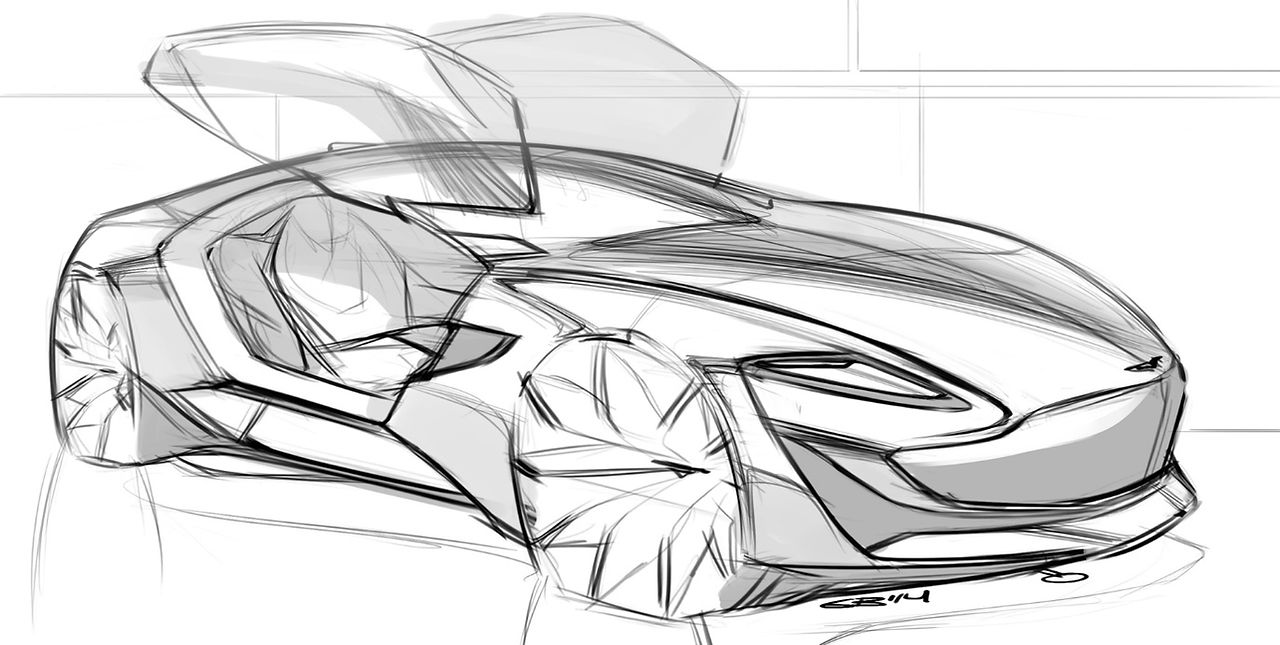
NEXODES 1Sketch by Grigory Butin) Sketch by Alex Pawar
Today, that relationship is changing. Generative AI can produce hundreds of vehicle concepts in the time it once took to complete a single polished sketch. Tools such as Vizcom and increasingly integrated AI workflows can transform rough drawings into convincing visualizations, while automotive studios are experimenting with AI to accelerate everything from ideation to geometry. Kia Global Design, for example, worked with Autodesk Research on generative AI for wheel concepts, using sketches and keywords to generate multiple design directions.
NEXODES 3 AI-assisted tools NEXODES 4 AI-assisted tools
So, the obvious question is: does sketching still matter?
The answer is more complicated than either yes or no.
The Sketch Was Never Just a Picture
One of the biggest misunderstandings about automotive sketching is that its purpose is to create a beautiful image.
It isn't.
A to think. The first lines establish proportion. The next lines investigate stance. A wheel is moved. The roof comes down. The greenhouse becomes smaller. The front overhang changes. A shoulder line is exaggerated.
The sketch becomes a conversation between the designer and the idea. That is precisely why freehand ability remains valuable even as image generation becomes dramatically faster.
NEXODES 52026-Geely Galaxy Cruiser 700 official exterior sketches by Geely Design
Recent research into generative AI and transportation design has found that highly skilled sketching still provides advantages, while also pointing toward a changing role for designers from primarily designer-makers toward designers who increasingly curate, direct and collaborate with AI.
The pencil isn't disappearing. Its job is changing.
From Sketch → Render to Sketch → AI → Sketch
The traditional workflow was relatively linear:
Idea → thumbnail → sketch → refined sketch → Photoshop → 3D → render
The emerging workflow is much more circular:
Idea → sketch → AI → selection → sketch → AI → 3D → evaluation → sketch
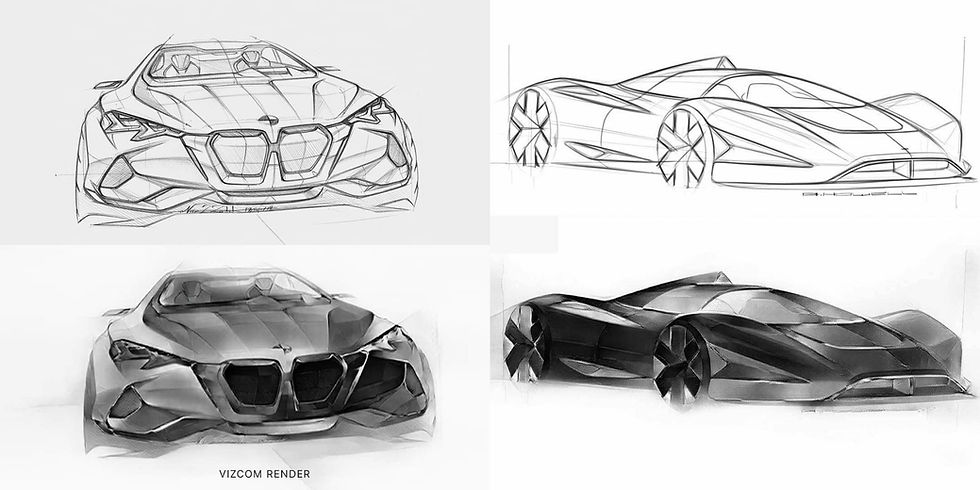
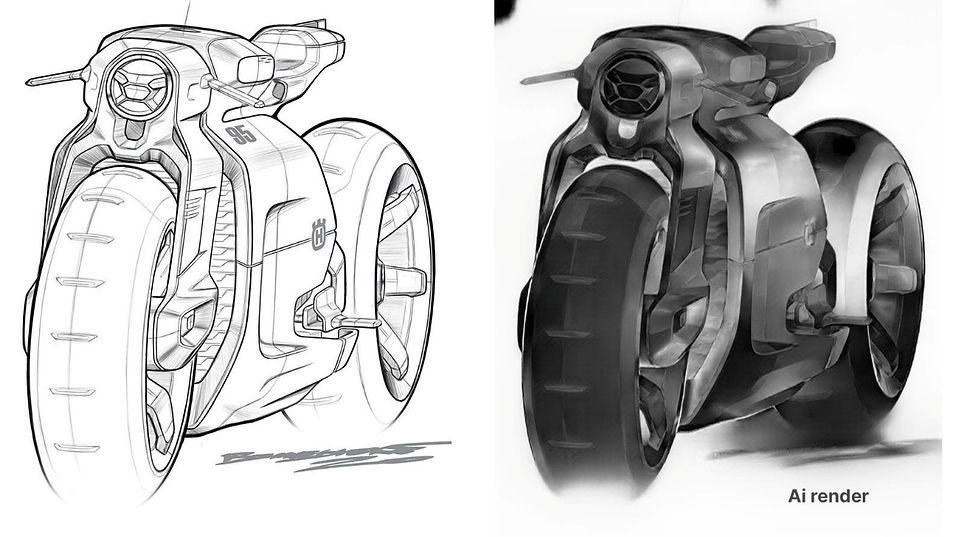
That distinction matters. AI is increasingly becoming another surface on which designers can think.
A rough side view can become a photorealistic vehicle. A designer can then paint over the result, change the wheelbase, modify the greenhouse and generate another iteration. Autodesk's latest design-studio workflow illustrates this direction: marked-up sketches can be converted into photorealistic images, while newer tools can take aligned visual references toward 3D meshes.
The future therefore may not be sketching versus AI. It may be sketching with AI.

What AI Is Really Good At. AI has an obvious advantage: volume.
A designer might spend hours producing variations of a theme. AI can explore hundreds of visual possibilities almost immediately. That makes it particularly powerful during the early exploration stage.
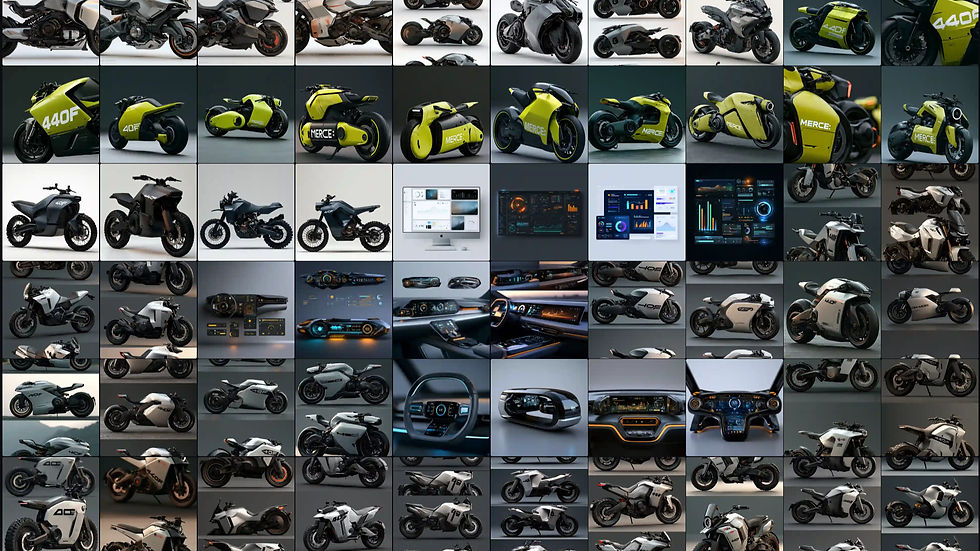
It can help answer questions such as:
What happens if the greenhouse moves backwards?
What would this proportion look like as a crossover?
How might this theme translate into a pickup?
What if the surfacing became softer?
How could the same design language work on a compact vehicle?
Its generative system was designed to reproduce part of the early design workflow starting with keywords and references and generating numerous possibilities that designers could evaluate and refine.
AI is therefore exceptionally good at expanding the search space.
But transportation design isn't simply a search for attractive images.
The Problem with Beautiful AI Cars
AI has become remarkably good at producing vehicles that look right. But looking right and being designed are different things.
A generated vehicle can have beautiful surfaces but inconsistent proportions.
A wheelbase can subtly change between views. The A-pillar may move. The glasshouse can become physically impossible. The character line may disappear when the vehicle is viewed from another angle. The door architecture may not make sense. The suspension, manufacturing strategy, visibility, ergonomics and package may be completely unresolved. And perhaps most importantly, the image may have no design intention behind it.
high-fidelity imagery during early concept development. by Alex Pawar high-fidelity imagery during early concept development. by Alex Pawar high-fidelity imagery during early concept development. by Alex Pawar
This is where the transportation designer becomes essential. AI can generate possibilities. The designer decides which possibility deserves to exist.
The New Skill: Direction
This could become one of the biggest changes in design education. For decades, students were encouraged to develop three fundamental abilities: See. Think. Draw.
Increasingly, another skill is being added: Direct.
The designer must know what to ask for, what references to provide, what to reject, what to develop and what to completely redraw. That requires a strong design vocabulary. If you don't understand proportion, AI cannot teach you good proportion. If you don't understand stance, AI can give you thousands of stances, but you may not know which one works. If you don't understand surfacing, you can generate beautiful reflections without understanding why they work. AI therefore potentially makes fundamental design knowledge more important, not less.
early concept development. by Alex Pawar
So, Should Transportation Designers Still Learn to Sketch?
Absolutely.
But perhaps the objective needs to change. Students shouldn't learn sketching simply because “automotive designers need to draw cars.” They should learn it because sketching teaches them to see and control form.
Perspective. Ellipses. Proportion. Volume. Light.
Surface transitions. Packaging. Gesture. Visual hierarchy
Most importantly, sketching develops the ability to make decisions quickly.
A designer who can draw a vehicle from imagination isn't necessarily better than someone who cannot. But a designer who understands why a line moves, why a wheel sits where it does, why the cabin has a particular proportion and why a surface turns in a particular way possesses something AI cannot automatically provide: intent.
The Software Toolbox Is Changing
The traditional transportation designer's toolbox has already evolved enormously.
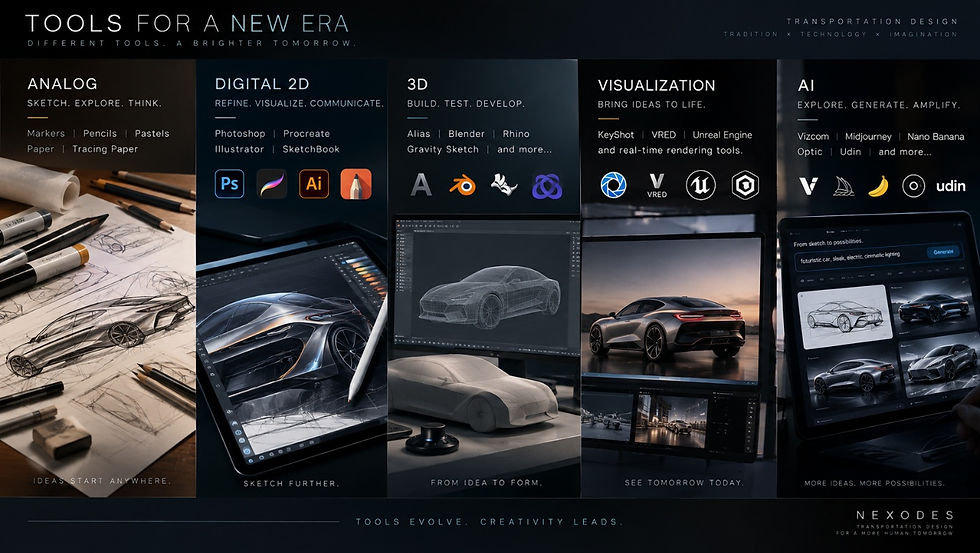
The interesting part isn't that one tool will replace another.
It is that the boundaries between them are disappearing.
A sketch can become a render.
A render can become a sketch.
A sketch can become a 3D mesh.
A 3D model can generate new images.
The workflow becomes fluid.
The End of the "Perfect Sketch"?
There is another cultural shift happening. For years, automotive design portfolios rewarded the polished hero sketch. A dramatic perspective. Perfect reflections.
Beautiful wheels. Perfectly controlled markers.
But if AI can produce a highly polished vehicle image in seconds, the value of the polished image alone inevitably decreases.

NEXODES 17 Image by Alex Pawar, created with AI assistance for NEXODES
The Portfolio Problem
There is another major consequence for design students. For years, a polished automotive sketch was one of the strongest elements of a transportation-design portfolio. But what happens when anyone can create a highly polished automotive image with AI? The image itself becomes less distinctive.
The process becomes more important. Future portfolios could increasingly show:
Research → Ideation → Sketches → AI exploration → Selection → Refinement → 3D → Final
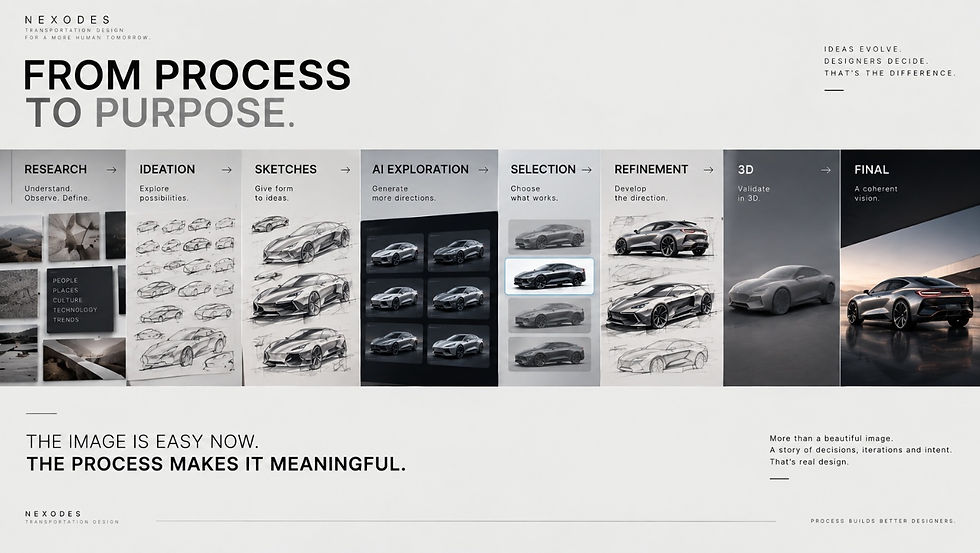
Instead of simply showing a beautiful final vehicle, the designer demonstrates how the idea evolved. That could be a healthy change. Transportation design is not a competition to make the prettiest image. It is a discipline built around problem-solving, storytelling and decision-making.
The Rise of the Designer-Curator
This doesn't mean designers become prompt engineers. The strongest future designers will probably be hybrids.
They will still sketch. They will understand clay. They will understand digital modeling. They will understand rendering.
But they will also understand how to use AI as a creative partner.
The designer's role moves slightly upstream:
“Is this the right idea?”
That is a much harder question.
AI can generate 100 versions of a futuristic SUV.
But should the vehicle be an SUV?
Should it have four doors?
Should it be aggressive?
Should it look technological?
Should it communicate luxury through minimalism instead?

Those decisions require cultural understanding, brand knowledge, user empathy, engineering awareness and design intuition.
AI can assist with the exploration. It cannot remove the responsibility of choosing.
Pencil + AI, Not Pencil vs AI
The most interesting future isn't one where transportation designers stop sketching.
It is one where sketching becomes part of a much faster creative loop.
A designer sketches.
AI visualizes.
The designer critiques.
AI generates alternatives.
The designer redraws.
3D tests the proportion.
The designer returns to the sketch.
The process becomes faster, more experimental and less linear.

The pencil becomes the anchor. AI becomes the amplifier.
And that may be the most important lesson for young transportation designers.
Don't compete with AI at producing images.
Learn to create ideas that AI cannot easily arrive at on its own.
Learn proportion. Learn perspective. Study architecture, fashion, nature, engineering, culture and human behaviour. Understand why a vehicle feels confident, elegant, playful, intimidating or calm.
Then use AI to explore those ideas faster.
Because the future transportation designer probably won't be the person who can generate the most images.
It will be the person who can look at a hundred possibilities and confidently say:
“This is the one and here's why.”



Comments